
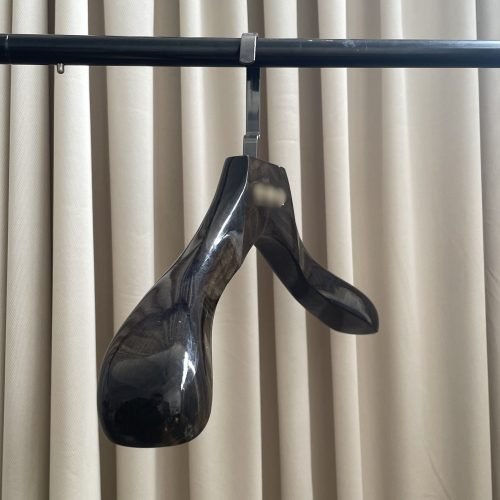
You unbox a fresh batch of black hangers . The finish is flawless. Deep black. Smooth to the touch. Three months on the rack, and tiny white speckles start appearing along the shoulder. The wood is showing through. Another month, and chips are flaking onto a customer’s white shirt collar.
Black finish doesn’t fail randomly. It fails for specific, predictable reasons — most of which can be caught before you place a wholesale order. Here’s what causes chipping and how to spec a finish that lasts.
Why the Black Finish on Wooden Hangers Chips in the First Place
The problem usually isn’t the paint or lacquer itself. It’s the bond between the finish and the wood. Wood expands and contracts with humidity and temperature changes. The finish doesn’t. When the wood moves and the coating can’t, stress builds at the surface. Eventually, the coating cracks. Then it chips.
Cheap wood hangers skip a critical step: sealing the wood before applying color. Raw wood soaks up the first coat unevenly. Some areas get too much. Others get too little. The thin spots are where chipping starts weeks later. A proper clothes hanger finish process uses a base sealer coat first, then the black color coat, then a clear topcoat. Three layers. Most budget black hangers wholesale orders use one — stain mixed with a thin lacquer sprayed on in a single pass. It looks fine in the photo. It fails on the rack.
Lacquer, Paint, or Stain — Not All Black Finishes Are the Same
Lacquer-based finishes are the most common on black hangers . They dry fast. They’re affordable. And on a sealed wood base with a clear protective topcoat, they hold up well through daily handling. The catch is that lacquer doesn’t flex. In stores with big temperature swings — near windows, by HVAC vents — the wood movement over time creates micro-cracks in the lacquer. Eventually, those cracks become chips.
Water-based acrylic paints are more flexible. They move slightly with the wood, which reduces stress cracking. The trade-off is scratch resistance. Acrylic is softer than lacquer and picks up fine scratches from hanger-on-hanger contact on packed racks. For a boutique where hangers are spaced apart and handled gently, acrylic is the better long-term choice. For a high-volume store where bulk hangers bump against each other constantly, lacquer with a tough clear coat wins.
Oil-based stains work differently. Instead of sitting on top of the wood, they soak into the grain. There’s no surface layer to chip — because there’s no surface layer at all. The trade-off is depth. A stained black finish reads as dark brown or charcoal in bright light, not true black. And the wood grain remains visible, which can be a look you love or one that clashes with a sleek modern brand identity.
The Areas That Chip First on Black Hangers
Chipping doesn’t spread evenly across the hanger. It hits specific spots hardest. The hook base is the number one chipping zone. Metal against finished wood, every time the hanger lifts and drops back onto the rack rod. That small impact zone chips within weeks on poorly finished black hangers .
The shoulder tips are next. They knock against other hangers when staff slide garments along the rack. With lacquer-only finishes, those knocks leave tiny white dots. Then the hanger hole edge — where the metal hook threads in. If the hole was drilled after finishing, the exposed raw wood around the thread edge absorbs moisture and swells. That swelling pushes the finish outward, and it chips from the inside.
On wood hangers with trouser bars, the bar attachment points are the last common failure zone. The metal bracket presses against the finish. Over months of trousers being placed and removed, that pressure point flakes. A nylon washer between the bracket and the wood prevents this entirely. Most factories don’t use one unless you ask.
How to Test Finish Quality Before You Order Black Hangers Wholesale
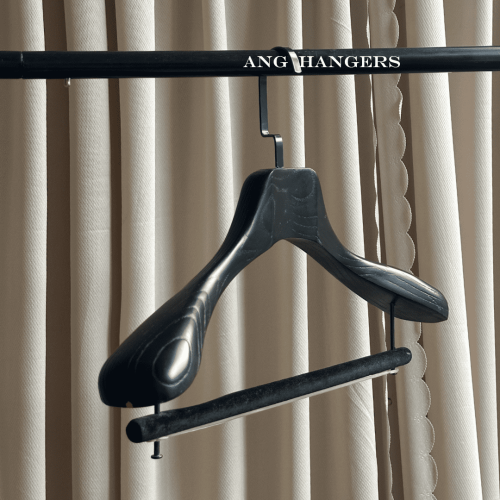
Photos won’t tell you. A supplier’s catalog shot shows fresh black hangers under perfect lighting. Here’s what actually predicts chipping.
Get a sample. Run your fingernail along the shoulder edge with medium pressure. A quality finish feels like glass — nothing happens. A cheap finish leaves a faint white line where the coating compressed. Now take that same sample and flex the shoulder bar gently. Listen. If you hear faint crackling, that’s the finish separating from the wood. It hasn’t chipped yet. But it will.
The scratch test matters too. Lay the hanger on a table. Drag another hanger across its shoulder once, the way they contact each other on the rack. A good clothes hanger finish shows nothing. A weak one leaves a visible mark. Do this test with every black hangers wholesale sample you receive. It predicts what the rack looks like in three months.
Ready to Order Black Hangers That Stay Black?
Black hangers don’t have to chip. A three-layer finish, sealed hook holes, and nylon washers at hardware points — those three specs together eliminate most of what causes flaking on the rack. The per-unit cost difference is negligible compared to replacing inventory and explaining to a customer why there’s black dust on their new white shirt.
At AngHanger , we manufacture black hangers with sealer-base-topcoat finishes, post-drill sealing, and nylon hardware washers — built for stores that need black to stay black. We also produce wood hangers in natural, stained, and custom colors, plus garment bags and packaging. Samples ship first so you can run the flex test and scratch test yourself.
 English