custom garment label Legal Requirements: 4 Must-Include Details to Avoid Fines
Jake, an activewear brand owner, got a $1,200 FTC fine last year—his labels said “100% cotton” for 80% polyester leggings. “I didn’t know mislabeling is fraud,” he said. “That fine hurt my budget.”
Clothing labels are legal documents—miss key details, and you face fines or recalls. Below are the 4 non-negotiable details, plus where custom garment label and Woven Label fit in.
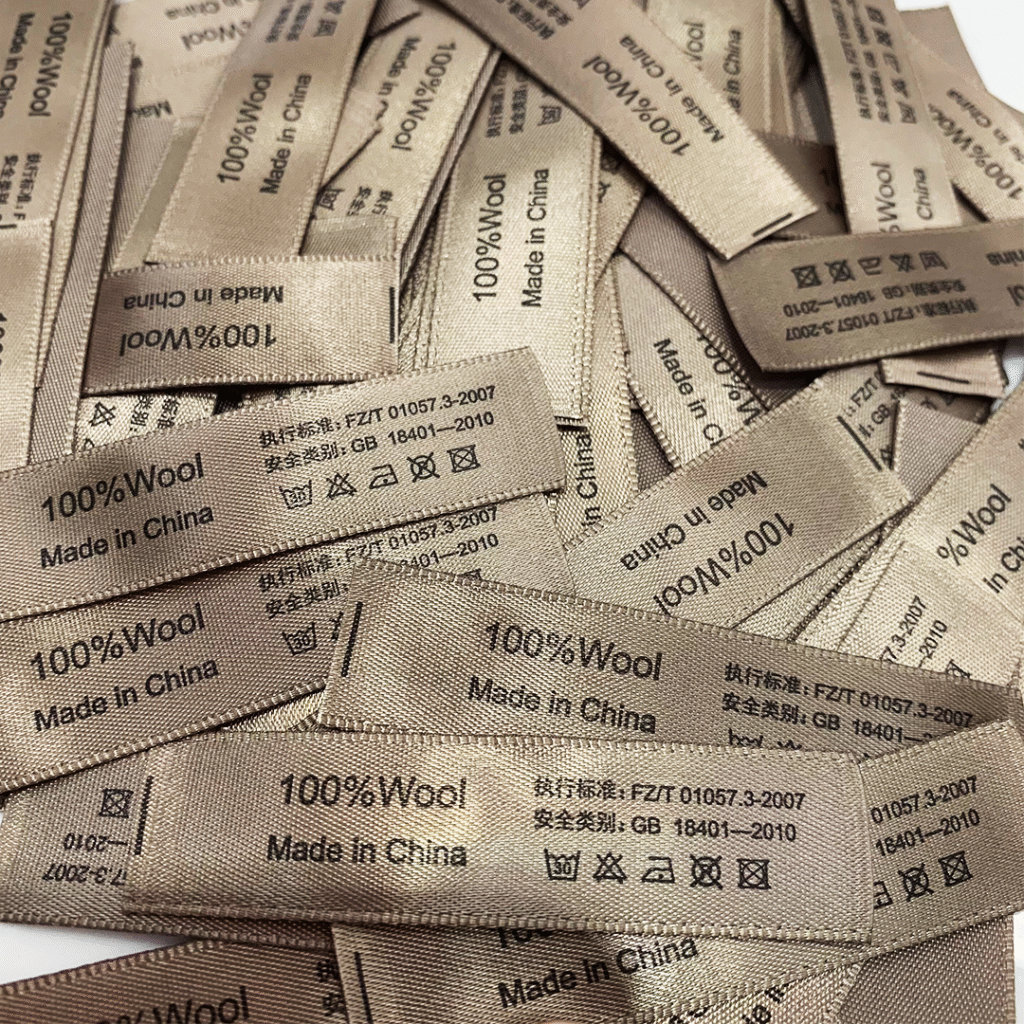
Fiber Content: Be Exact (No Lies)
FTC and EU REACH rules demand exact fiber percentages (not “natural fibers” or false claims).
Jake now labels leggings “80% polyester/20% cotton” on every custom garment label (sewn in waistbands). He added: “Tested for fiber accuracy” to build trust.
Rules:
1:List fibers by weight (heaviest first: e.g., “60% cotton/40% pol1yester”).
2:Include fibers over 5% (under 5% = “other fibers”).
3:Skip “eco/organic” without certification (e.g., GOTS).
Care Instructions: Clear (No Vagueness)
Vague instructions (e.g., “wash as needed”) cause complaints and fines.
A LA dress brand got a CPSC warning: They labeled silk dresses “machine washable,” leading to 30+ shrunk returns. Now they use Woven Label (won’t fade) that says: “Dry clean only. No bleach.”
Rules:
1:Use standard symbols + text (for clarity).
2:Be honest (don’t lie about machine washability).
3:For multi-fabric items, follow the most delicate part’s care.
Country of Origin: “Made in X” Isn’t Optional
Label where the garment was assembled (not just fabric origin).
A Chicago kids’ brand got a warning for “Made in USA” jackets sewn in Mexico. They corrected labels to “Assembled in Mexico from U.S. materials.”
Rules:
1:U.S. brands: 50%+ U.S.-made to use “Made in USA” (FTC).
2:EU brands: “Made in [Country]” (full assembly) or “Assembled in [Country] from imported materials.”
Safety Standards: Mandatory for Kids’ Wear
Kids’ clothing (0–12) needs certifications (CPSIA for U.S., CE for EU) to prove no harmful chemicals.
A Portland onesie brand recalled 500 units—labels lacked CPSIA certification. “I thought ‘soft = safe,’” the owner said. Now custom garment label say: “CPSIA compliant. Tested for lead.”
Rules:
1:List certification numbers (e.g., “CPSIA #12345”) for verification.
2:Kids’ sleepwear: Add flame resistance (e.g., “Meets 16 CFR 1615”).
How to Avoid Mistakes (Simple Steps)
Jake now does 3 things:
1:Tests 10% of batches for fiber content ($20/lab test).
2:Uses Woven Label for permanent details (fiber, origin) + small printed tags for care (easy to update).
3:Checks FTC/CPSC sites quarterly for rule changes.
“A $20 test is cheaper than a $1,200 fine,” he said.
Wrapping Up
custom garment label rules protect consumers—and save you from fines. Include fiber content, clear care, origin, and safety info. Whether you use Apparel Label for activewear or Woven Label for kids’ clothes, be accurate and double-check.
Next time you design a label: “Would a regulator approve this?” If not, fix it. Your budget (and reputation) will thank you.
Need Expert Guidance?
ANG specializes in custom packaging for global fashion brands. Contact us for a free consultation Design and Samples.
 English